Article Directory
Most disputes over performance knit fabric are settled by a test report, not by a hand feel. A 180 GSM interlock that drapes correctly in a sample room can still fail AATCC 135 after three home launderings, exceed the plus or minus 5 percent dimensional change band, or recover too slowly to meet the growth limit written into the tech pack. None of those failures are visible on a hanger, and all of them surface after the cutting table has already been committed.
Apparel manufacturers pay for that gap twice: once in rejected yardage, and again in a garment that sags at the knee, shines at the seat or pills under a backpack strap after ten wears. The decisions that determine the outcome are made before the first bulk roll is knitted, and nearly all of them fit on a single specification sheet.
A performance knit fabric should be locked to at least six measurable parameters before a mill quotes on it: mass per unit area, fibre composition, stretch and recovery, moisture management, dimensional stability, and colourfastness. Hand feel and drape are outcomes of those numbers, not independent qualities that can be judged on their own.
The table below lists the checks that most often decide whether a bulk shipment is accepted or claimed against. Each row can be written into a purchase order as a single line.
| Parameter | Typical target | Reference method |
| Mass per unit area | 140 to 280 GSM, set by end use | ISO 3801 or ASTM D3776 |
| Fibre composition | 12 to 22 percent elastane in four-way stretch knits | ISO 1833 |
| Stretch and recovery | 60 to 120 percent elongation, growth under 5 percent after 30 minutes | ASTM D4964 |
| Moisture management | One-way transport and drying rate above the agreed base line | AATCC 195 |
| Dimensional stability | Within plus or minus 3 to 5 percent after three launderings | AATCC 135 or ISO 6330 |
| Colourfastness | Grade 4 or better to washing and to perspiration | ISO 105-C06 and ISO 105-E04 |
| Pilling and abrasion | Grade 4 at 2,000 rubs for leggings and team wear | ASTM D4970 or ISO 12947 |
A knit structure fixes the failure mode before the fibre blend is even chosen: at equal weight, interlock and 2x2 rib hold shape better than single jersey, while mesh ventilates better than both and carries less bursting strength.
Structure is the cheapest lever available. Moving a leggings programme from single jersey to interlock at the same 200 GSM removes edge curl and improves recovery, without changing the fibre cost per kilogram.
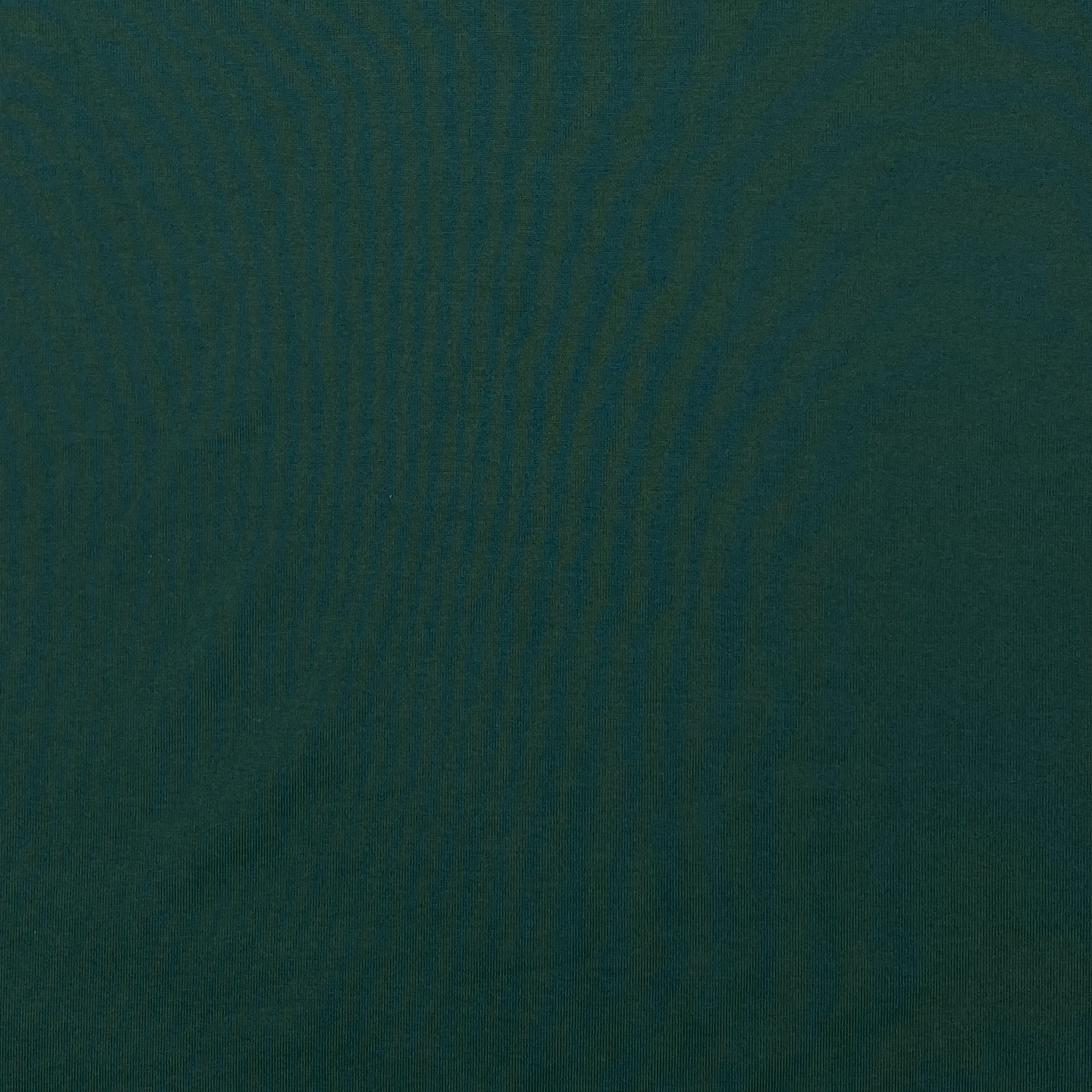
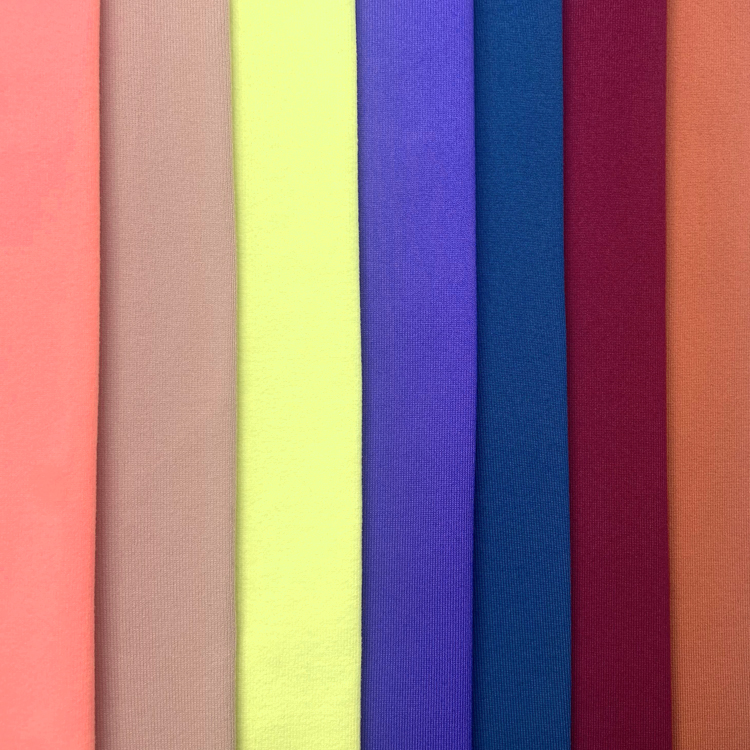 PERFORMANCE KNIT MATT & PLAIN HT045PERFORMANCE KNIT MATT & PLAIN HT045View Product →
Nylon with elastane remains the default for high-stretch activewear because nylon gives a softer hand and better abrasion resistance at the same elastane percentage, while polyester with elastane dries faster, holds colour better in chlorinated water and costs less per kilogram.
Elastane is the smallest share of the blend by weight and the largest share of the risk. Above roughly 22 percent elastane, extra stretch adds very little recovery and starts to raise compressive force, which shows up as discomfort in long-wear leggings and as higher material cost. Recovery depends more on knit structure, heat setting and the relaxation route than on the elastane percentage alone.
Recycled polyester and cationic polyester change the dyeing route rather than the comfort profile: cationic yarns dye to deep shades at lower temperatures, and recycled feedstock shifts costing and certification work more than it shifts hand feel.
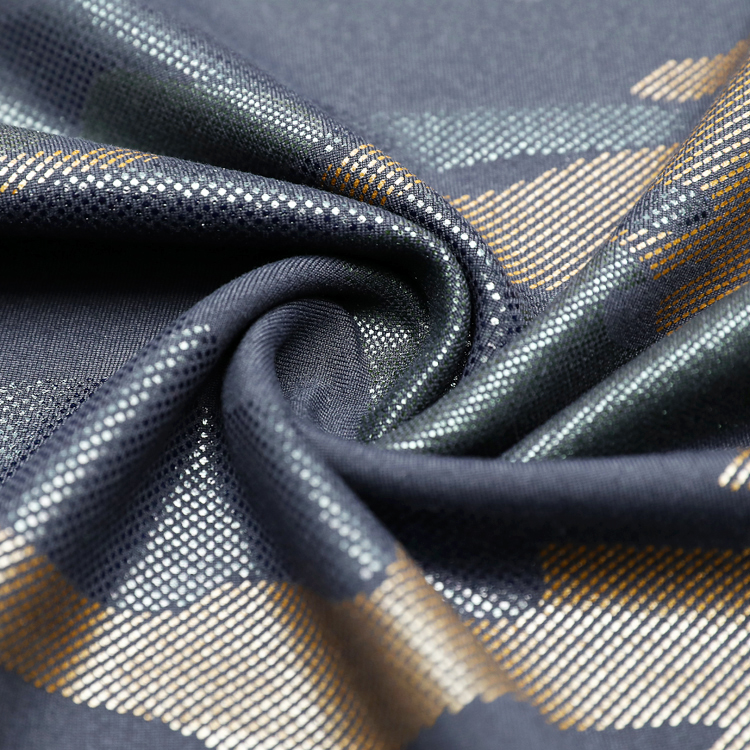
 HIGH STRETCH NYLON FABRIC HT928PERFORMANCE KNIT MATT & PLAIN HT045View Product →
Approve bulk against named methods rather than adjectives: AATCC 135 for dimensional change after laundering, ASTM D4964 for stretch and recovery, AATCC 195 for moisture management, ISO 105-C06 for wash colourfastness and ASTM D5430 for four-point fabric inspection.
Needle lines, shade banding and width variation account for most of the claims raised after a pilot run. The most common defects found in wholesale four-way stretch knit fabric are documented together with the inspection stage where each one should be caught.
Recycled content has to be traceable rather than asserted: the Global Recycled Standard and the Recycled Claim Standard both require chain-of-custody certification from the recycler through to the finished fabric, while Oeko-Tex Standard 100 covers restricted substances rather than recycled content.
Textile Exchange's Materials Market Report has tracked recycled polyester at close to 15 percent of global polyester fibre volume in recent reporting years, which means buyers now have enough qualified supply to insist on paperwork. Keep these four documents with every order:
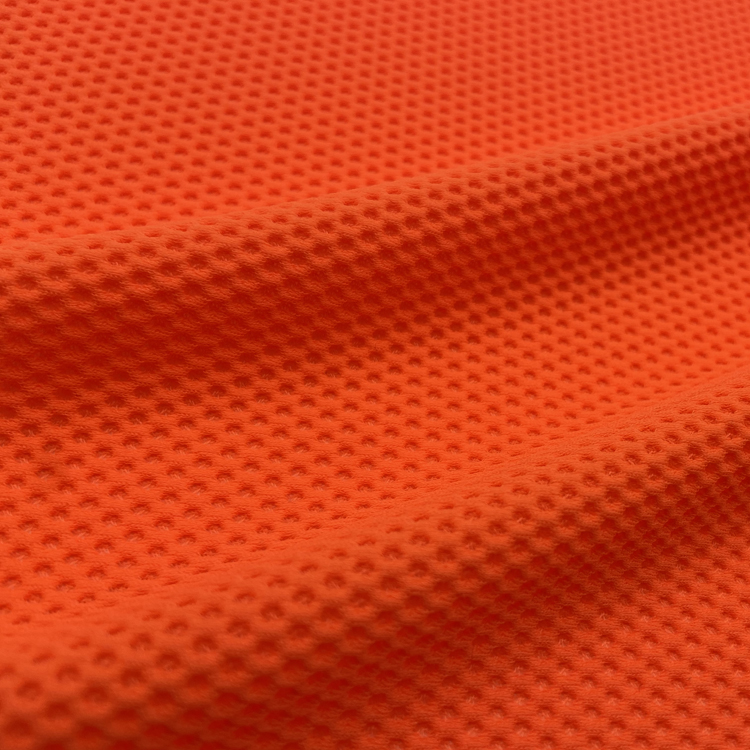
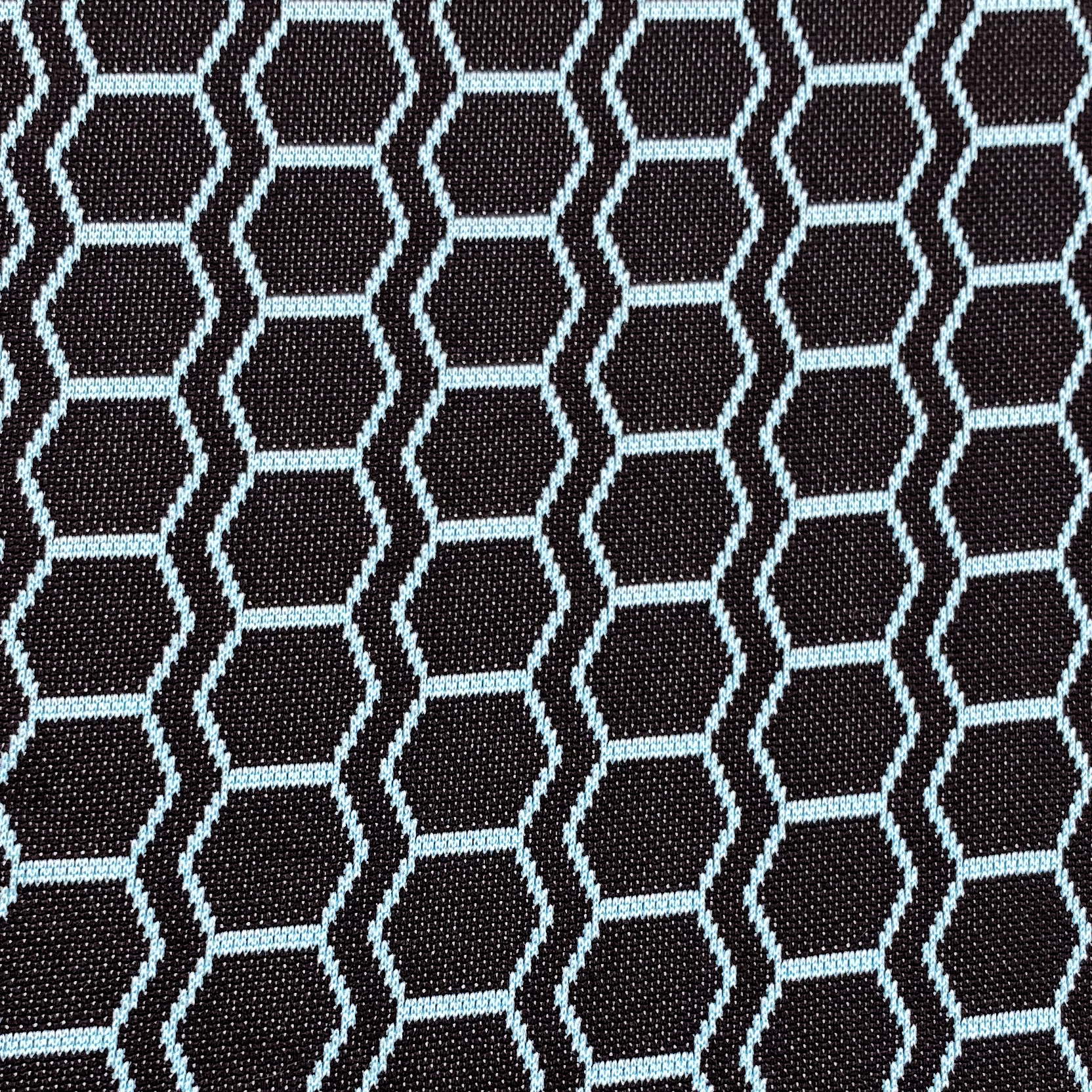 100% POLYESTER 150GSM 170CM HONEYCOMB RECYCLED POLYESTER FABRIC HT1317100% POLYESTER 150GSM 170CM HONEYCOMB RECYCLED POLYESTER FABRIC - Sustainable High-Performance TextileView Product →
Price, minimum order quantity and lead time move together, because colour batch minimums, yarn lot size and the finishing route set all three at the same moment.
Request 30 to 50 metres per colourway for cut-and-sew trials plus 2 metres retained as a sealed reference, and confirm in writing that the sample comes from the same yarn lot and machine gauge planned for bulk. Yardage produced on a different gauge is a hand-feel test, not a production trial.
Expect plus or minus 3 percent for synthetic-rich four-way stretch knits and plus or minus 5 percent for cotton-rich blends after three launderings under AATCC 135. A mill that promises zero shrinkage is normally quoting a compacted or pre-relaxed finishing route, so ask which route and price the width loss that comes with it.
No. Recovery is governed by knit structure, heat setting and relaxation as much as by elastane content, and above roughly 22 percent elastane the extra stretch mainly raises compressive force and cost. ASTM D4964 measures the number that matters: the percentage of length not recovered after a defined stretch and rest period.
Four items: a test report naming the method and the measured result, a GRS or RCS transaction certificate whenever recycled content is claimed, the Oeko-Tex Standard 100 certificate number, and a sealed retained sample approved against the standard. Missing any one of the four turns a technical question into a commercial dispute.

As Yitai, since 2004, we have manufactured sportswear knitted fabrics such as interlock fabric, nylon fabric, spandex fabric, polyester fabric etc. With excellent R&D group, marketing team, quality control system, experienced dyeing & finishing supporting facility and customer service system.
Haining Yitai Knitting Co., Ltd
No. 198 Canghai Road, Warp Knitting Zone, Haining City, Zhejiang, 314419, China Tel: +0086 135 6738 5757 Email: [email protected] [email protected] [email protected]FOLLOW US



 英语
 中文简体