Article Directory
A compression legging made with 12 percent spandex performs like a training base layer; the same silhouette sewn from a 22 percent spandex interlock at 240 GSM actively supports the leg and holds its shape through a full workout. The distinction is not branding; it is measurable fabric engineering. Close-fitting sportswear transfers nearly every performance requirement onto the knit structure: controlled stretch, rapid recovery, moisture transport, surface durability, and consistent reproduction across production batches.
This guide lays out the five fabric properties that determine how compression wear and close-fitting sportswear perform, with concrete specification ranges that a product developer can take directly to a fabric supplier.
Stretch and recovery decide whether a close-fitting garment supports muscles or bags out after the first wash. Elastic recovery, measured by stretching a fabric sample and watching it return to size, is the first number a compression wear developer should request from a mill.
For compression wear, specify a four-way stretch knit fabric with 150 to 220 percent elongation in both length and width, plus recovery above 90 percent within 30 seconds of release. Spandex content normally sits between 18 and 25 percent for firm compression, and between 10 and 15 percent for light shaping garments.
 High Stretch Nylon Fabric for Compression WearThis nylon knit offers the elongation and recovery needed for compression garments, meeting the 150-220% stretch and over 90% recovery requirements discussed here.View Product →
Elongation and recovery values come from ASTM D4964, the standard test for stretch properties of knitted fabrics. Ask for the report before sampling, not after. Recovery is calculated from residual extension after repeated stretch cycles, and it is the metric that separates a compression fabric from an ordinary stretch fabric.
Spandex above 25 percent adds weight and raises garment pressure without adding useful support. The practical nylon-to-spandex ratio for most compression styles stays between 75/25 and 82/18. Our guide to nylon-spandex ratios in four-way stretch knit fabric compares elongation and recovery across common blends.
Nylon-spandex blends dominate compression wear because nylon delivers better elastic recovery, abrasion resistance and a smooth hand feel; polyester-spandex blends win when moisture transport, quick drying and color fastness lead the specification.
The two fiber bases behave differently in the same knit structure. A nylon single jersey recovers quickly and feels soft against the skin; the same structure in polyester wicks faster but holds a firmer, drier touch. For garments worn directly against the skin during long training sessions, most developers choose nylon for recovery and comfort, then add polyester mesh or textured channels in high-sweat zones.
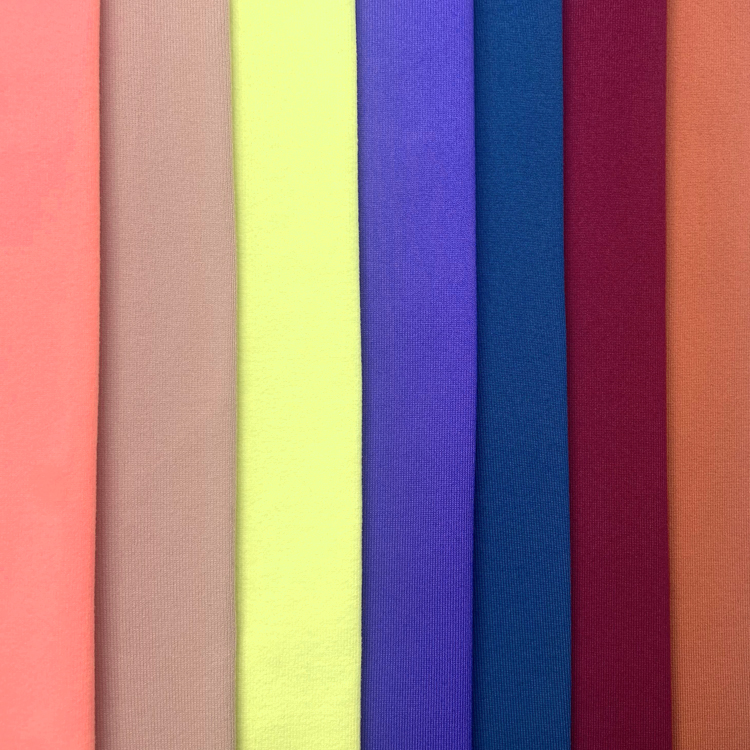 Performance Knit Matt & Plain FabricThis nylon-based performance knit provides quick recovery and softness against skin, making it a strong choice for long training sessions where comfort matters.View Product →
| Property | Nylon-Spandex | Polyester-Spandex |
| Elastic recovery | Excellent | Moderate |
| Moisture wicking | Good | Excellent |
| Abrasion resistance | Excellent | Good |
| Hand feel | Soft and smooth | Firm and dry-touch |
| Color fastness | Good | Excellent |
| Typical use | Compression leggings, base layers | Training tops, cycling jerseys |
For muscle support and shape retention, nylon-spandex is the stronger base. Choose polyester-spandex only when the garment prioritizes maximum wicking and color durability.
Fabric weight, measured in grams per square meter, sets the pressure profile of a close-fitting garment: lower GSM allows freedom and breathability, higher GSM adds sculpting and support.
For compression leggings and cycling bibs, the working range is 200 to 280 GSM. Below 180 GSM the fabric does not generate enough tension to support muscle; above 280 GSM the garment becomes hot and restrictive for most training applications.
 Matt Stretchy Single Jersey FabricA versatile single jersey that adapts to different weights, suitable for close-fitting tops that require a lighter compression feel and good drape.View Product →
The knit structure converts the same GSM into very different fabrics. An interlock at 230 GSM feels dense and flat, ideal for firm compression panels. A single jersey at 230 GSM drapes and stretches differently, which suits close-fitting tops with a lighter compression feel. Rib structures add vertical stretch and appear in cuffs, waistbands and side panels.
Compression knit fabric must move sweat away from the skin before it cools and chafes, so moisture management is a measurable requirement, not a marketing feature.
Check three numbers before approving a lot: vertical wicking rate, drying time and air permeability. Fabrics that combine a flat-knit face with textured inner channels, or that use mesh zones in high-sweat areas, keep the body dry during continuous effort. A compression garment that traps sweat against the skin fails the first job of close-fitting sportswear.
Moisture management is verified with AATCC 195 or ISO 11092. Request the report together with air permeability data, especially when the garment will be worn for more than 60 minutes of continuous exercise.
Close-fitting garments are washed often, stretched hard and rubbed against themselves, so pilling resistance and dimensional stability belong in the fabric specification.
High-denier nylon filaments and tightly twisted yarns resist pilling better than loose, low-twist constructions. For compression wear, ask for a Martindale abrasion result above 20,000 cycles and a pilling grade of 4 or higher after five home washes. Dimensional stability after washing should stay within plus or minus 3 percent in both directions; larger change means the spandex is degrading or the finishing heat-set was incorrect.
The best fabric specification is worthless if a mill cannot reproduce it, so qualifying a knit fabric supplier means verifying test data, batch consistency and dye-lot reproducibility.
Work through four checks before placing a production order:
Suppliers with in-house dyeing and finishing, such as Haining Yitai Knitting Co., Ltd., control the chain from greige knitting to final heat-setting, which narrows the gap between laboratory samples and production rolls. For the complete technical checklist, read how to choose high-performance nylon-spandex fabric for sportswear.
For firm compression, use 20 to 25 percent spandex on a nylon base. For light shaping and everyday close-fitting garments, 15 to 18 percent is sufficient.
Polyester-spandex wicks faster and dries quicker, but nylon-spandex recovers better and feels smoother. For muscle support and shape retention, nylon is the stronger choice.
Compression leggings typically range from 200 to 260 GSM. Lower GSM suits yoga and warm-weather training; higher GSM provides firm sculpting pressure.
Use ASTM D4964 to measure elongation and recovery. Stretch the fabric to a defined elongation, hold it, then release; the residual extension after 30 seconds indicates recovery, with 90 percent or better required for compression wear.

As Yitai, since 2004, we have manufactured sportswear knitted fabrics such as interlock fabric, nylon fabric, spandex fabric, polyester fabric etc. With excellent R&D group, marketing team, quality control system, experienced dyeing & finishing supporting facility and customer service system.
Haining Yitai Knitting Co., Ltd
No. 198 Canghai Road, Warp Knitting Zone, Haining City, Zhejiang, 314419, China Tel: +0086 135 6738 5757 Email: [email protected] [email protected] [email protected]FOLLOW US



 英语
 中文简体