Article Directory
A 220 GSM interlock and a 220 GSM single jersey can be knitted from the same yarn lot, dyed in the same jet, and still cut and sew like two different materials. The reason sits on the machine. Single jersey comes off one set of latch needles, while interlock is knitted on two needle beds and locked into a double-faced structure. That one construction decision drives opacity, widthwise stretch, elastic recovery, edge curl, yarn consumption and price per kilogram. In activewear programs, the wrong choice rarely shows up as a knitting fault. It shows up as see-through leggings, twisted side seams, or a shrinkage claim three washes after launch.
Single jersey is a weft knit built on one set of latch needles, producing a technical face of vertical V loops and a technical back of purl loops. Interlock is built on two needle beds and two yarn sets that interlock two 1:1 rib structures into a double-faced fabric whose two faces look alike.
That needle arrangement explains most of what buyers notice. A single jersey loop has nothing supporting it on the reverse side, so the wales incline slightly as the fabric relaxes off the machine. The visible results are curl at cut edges, a long widthwise stretch, and skewness that appears as a twisted side seam after laundering. Interlock balances each face loop against a reverse loop from the second yarn set, so tension spreads in two directions, edges lie flat, and the fabric holds shape without elastane.
Definition: interlock is a double-faced weft knit in which two 1:1 rib structures are knitted simultaneously on cylinder and dial needles and interlocked, so each face loop is balanced by a loop on the reverse side.
Weight follows structure. Because interlock feeds two yarn sets across the same cylinder width, at an identical yarn count it lands about 1.6 to 1.9 times heavier per square metre than single jersey, and a 30 inch machine runs 20 to 30 percent slower on the same diameter.
In activewear the practical working window is 130 to 190 GSM for 100 percent cotton or polyester single jersey, 180 to 240 GSM once 15 to 20 percent spandex enters the blend, and 200 to 280 GSM for interlock, rising to 240 to 320 GSM for the spandex interlock used in compression tights.
| Parameter | Single jersey | Interlock | What it changes on the garment |
| Needle configuration | One needle bed, cylinder only | Two needle beds, cylinder and dial | The structural basis for every other row |
| Typical finished weight | 130 to 190 GSM, and 180 to 240 GSM with spandex | 200 to 280 GSM, and 240 to 320 GSM with spandex | Opacity, warmth and cost per garment |
| Widthwise stretch without elastane | 25 to 40 percent | 15 to 25 percent | Fit range and pattern grade |
| Elastic recovery, ASTM D4964 | 70 to 85 percent without elastane, 92 to 95 percent at 18 to 20 percent spandex | 80 to 90 percent without elastane, 95 percent and above with spandex | Sagging at knees, waistbands and bust |
| Skewness after laundering, AATCC TM179 | 3 to 7 percent | 1 to 3 percent | Twisted side seams and leg panels |
| Opacity | Sheer below 160 GSM in pale shades | Opaque from roughly 190 GSM | Coverage in light colourways under stretch |
| Edge curl | High, needs heat setting or resin | Low, cuts flat | Cutting room speed and panel loss |
| Yarn use per square metre | Baseline | 1.6 to 1.9 times baseline | Price per kilogram and per garment |
Treat those columns as windows, not fixed values. Elastane percentage, yarn count, machine gauge and finishing route all move the numbers, and the test method used to measure a property matters as much as the property itself.
Moisture behaviour follows mass. A 150 GSM polyester single jersey wicks and dries faster than a 260 GSM interlock of the same fibre blend, because less material holds the water, while interlock wins on opacity, support and shape retention under load.
Shrinkage is where the two structures separate most clearly in claims data. Mills typically quote 5 to 7 percent widthwise shrinkage for cotton single jersey and 3 to 5 percent for cotton interlock after three home launderings following ISO 6330 or AATCC 135. On a fitted garment, that difference is the gap between a sample that passes and a size run that fails.
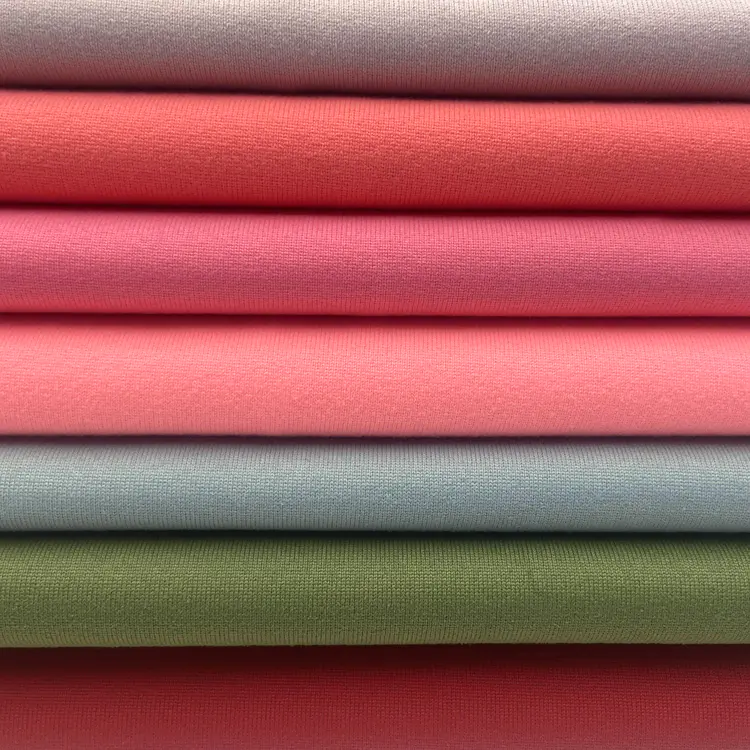
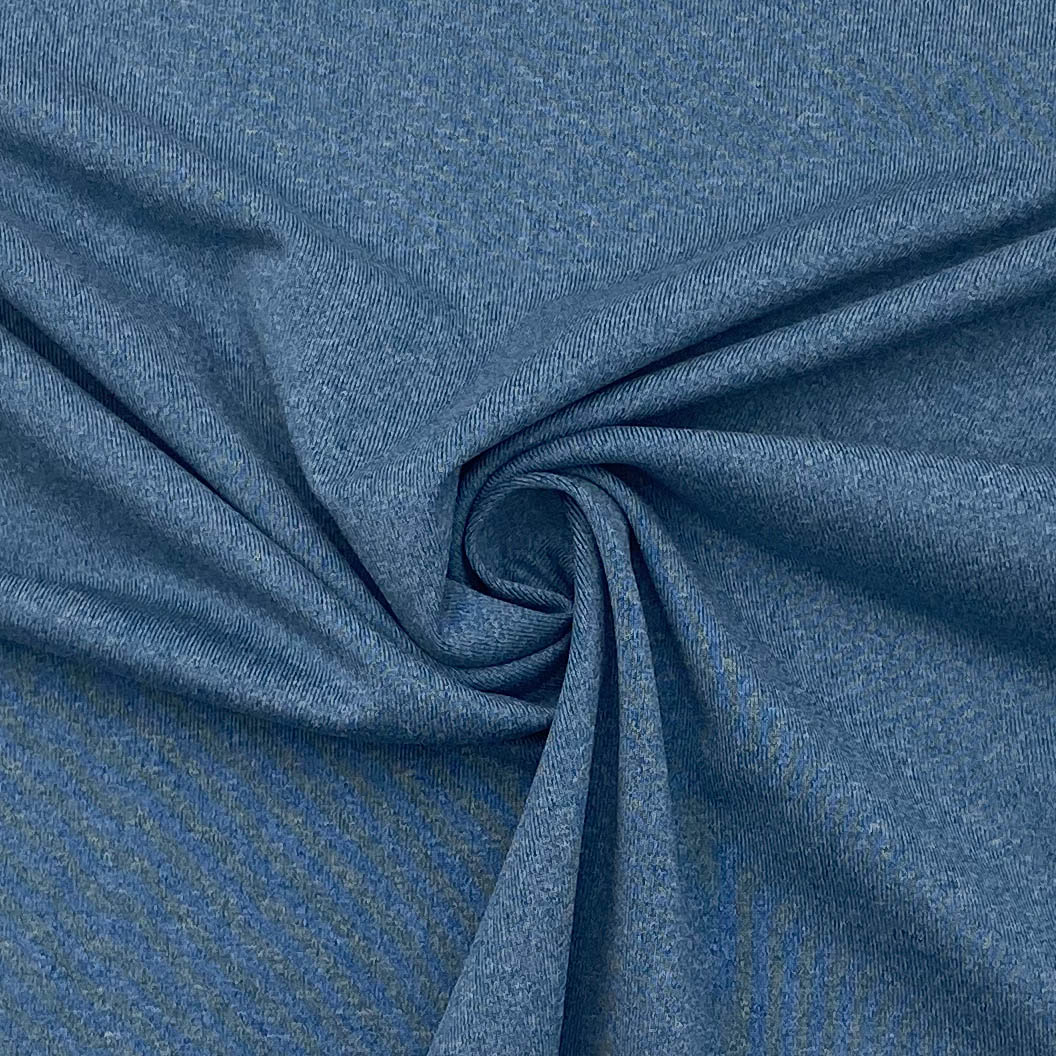
Pilling and abrasion behave differently too. The tighter double-faced structure of interlock resists surface fuzzing at the underarm and inner thigh, while a 150 GSM spun cotton single jersey shows pills sooner. For studio tops, where drape matters more than compression, a matte stretchy single jersey in the 180 to 200 GSM range keeps the garment light while staying opaque.
 MATT STRETCHY SINGLE JERSEY HT009-2PERFORMANCE KNIT MATT & PLAIN HT045View Product →
Interlock generally costs 15 to 35 percent more per kilogram than a comparable single jersey, because it consumes 1.6 to 1.9 times the yarn per square metre and knits 20 to 30 percent slower on the same machine diameter.
That premium does not always survive into the garment price. Single jersey edge curl forces extra handling and a wider selvedge trim in the cutting room, and higher spirality raises the risk of panels rejected after washing. On a 2,000 piece legging order, a 3 percent panel rejection rate can erase the saving on the cheaper fabric.
Compare landed cost per approved garment, not price per kilogram. Yarn, knitting, dyeing, cutting loss and rework all sit inside that number.
Dyeing and finishing add their own variables. The greater mass of interlock needs longer jet cycles and more rinsing water, while single jersey heats and cools faster but is more sensitive to over-stretching on the stenter, which appears as a wider, less elastic fabric that fails recovery testing on the finished roll.
Match the structure to the load. Single jersey suits lightweight, printable, fast-drying tops, while interlock suits garments where opacity, weight and recovery are non-negotiable.
For compression and support layers, a spandex interlock in the 240 to 300 GSM range is the safer starting point, provided the mill can hold GSM within plus or minus 5 percent and keep skewness under 3 percent. Mills that knit both structures on one floor, such as Haining Yitai Knitting Co., Ltd in Haining, Zhejiang, can run that comparison from a single yarn lot, which removes the yarn variable from the test.
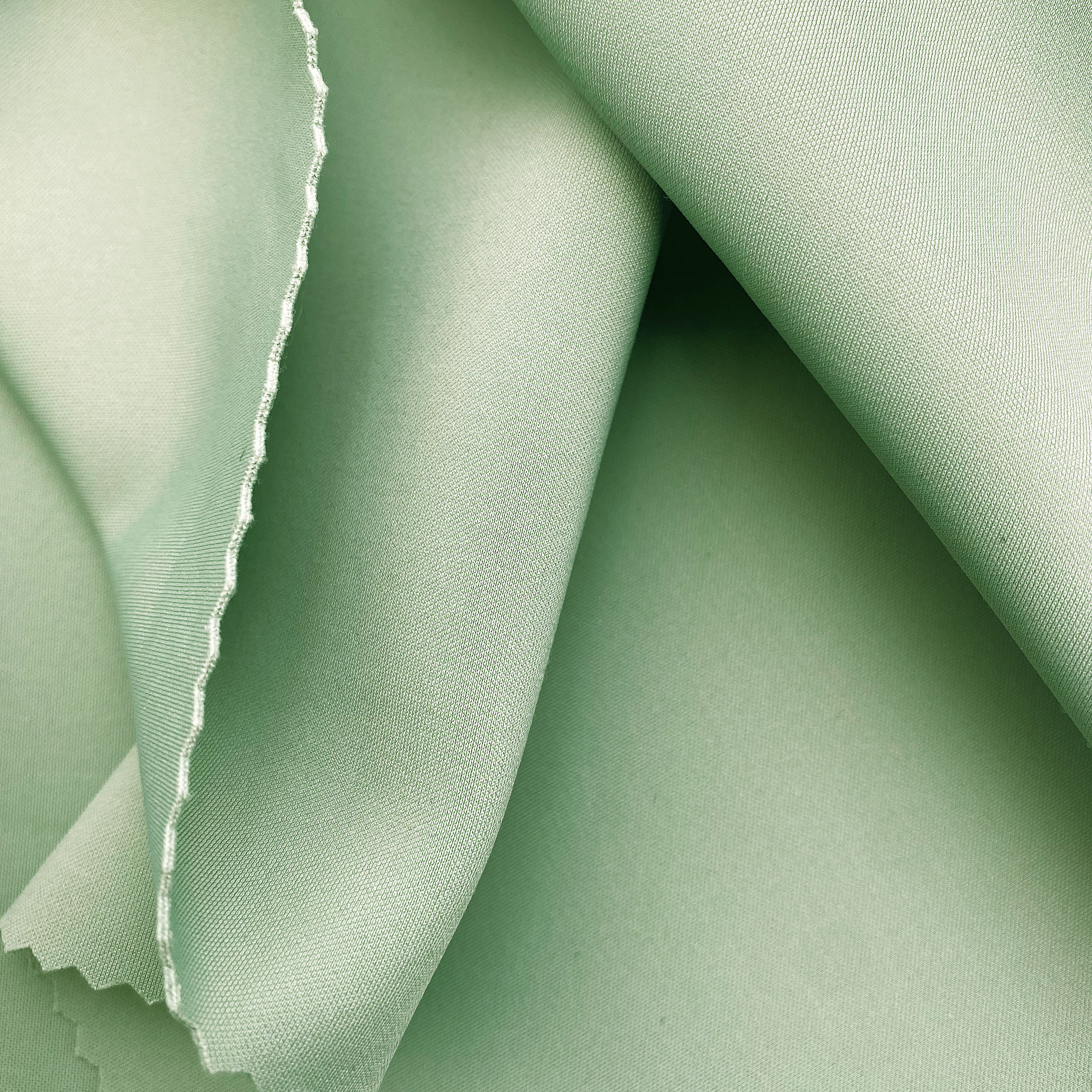 76% NYLON 24% SPANDEX WEIGHT 285GSM WIDTH 135 CM STRETCHY INTERLOCK HT1393The Stretchy Interlock is a heavy-duty technical knit fabric engineered for the performance apparel industry. Constructed with a 285 GSM weight, this material utilizes...View Product →
Six checks separate a workable knit from an expensive lesson, and all of them can be run on a 30 to 50 metre sample before any bulk order is placed.
Put needle configuration, yarn count, elastane percentage, finished GSM with tolerance and finishing route in writing, and state whether mass is measured on greige or finished fabric.
ASTM D2594 covers stretch and ASTM D4964 covers elongation and recovery. Run three cycles in both directions and target 90 percent recovery or better on any legging program.
Three home launderings per AATCC 135 or ISO 6330, then AATCC TM179 for skewness. Above 3 percent on interlock or 5 percent on single jersey, expect twisted seams at retail.
Pull a swatch 20 percent over a light box in the lightest colourway of the range. Many single jersey constructions pass a flat opacity check and fail this one.
AATCC 195 produces a liquid moisture management profile. Use it alongside an internal wear trial rather than as a substitute for one.
Thirty to fifty metres is usually enough for two garments per size. Judge the fabric after one wash, never on the roll.
Performance finishes belong in the same written specification. A quick-dry knit ordered without a named finish and test method often arrives with adequate wicking and no paper trail, which leaves the brand exposed on any performance claim printed on the hangtag.
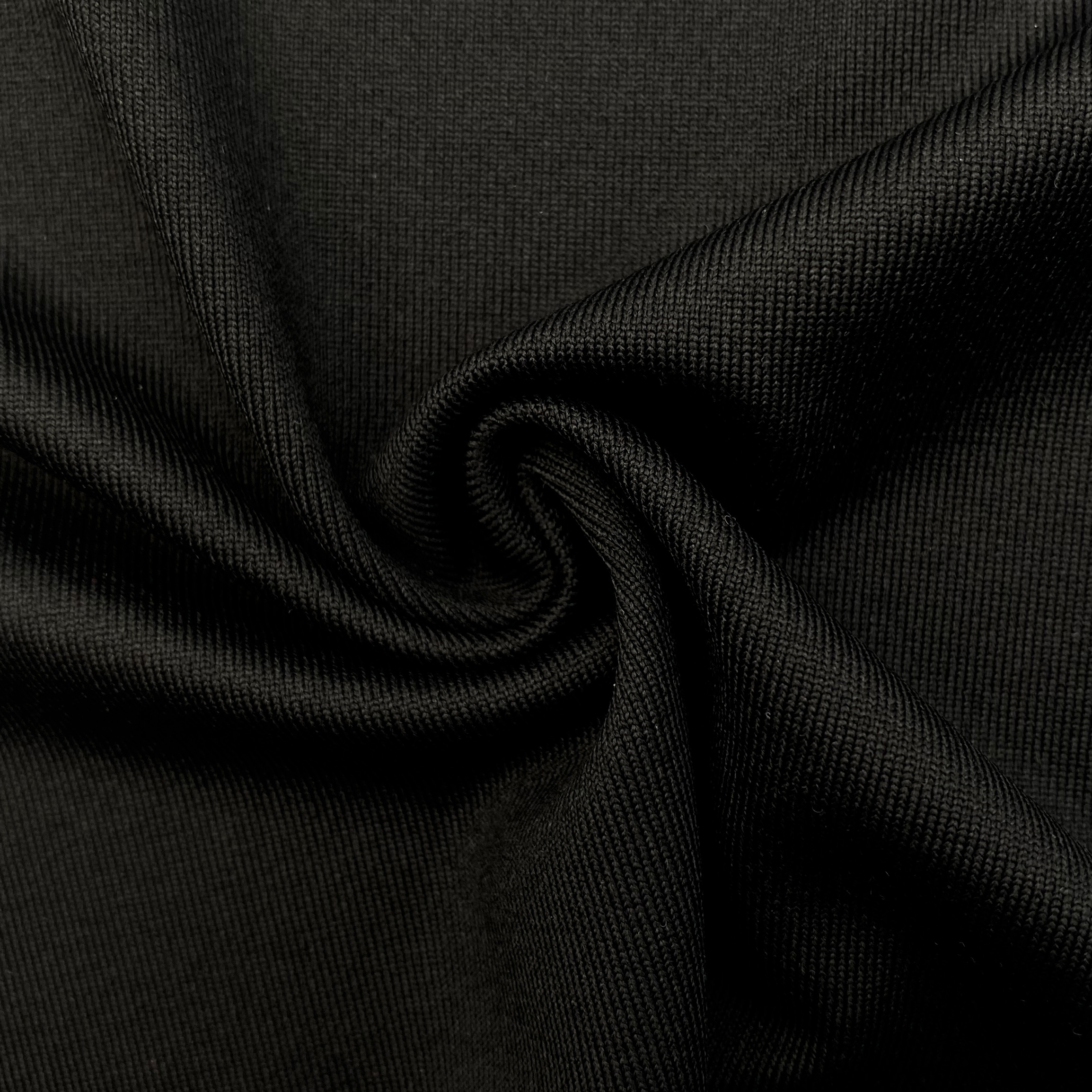
 BLACK QUICK DRY FABRIC HT1337PERFORMANCE KNIT MATT & PLAIN HT045View Product →
If the program involves linings, reversible panels or double-faced layering, our notes on interlock in apparel and lining applications cover the seam and drape questions that come up next.
At the same yarn count and machine gauge, yes. Interlock runs 1.6 to 1.9 times the mass per square metre because it knits two yarn sets at once. The rule breaks when yarn counts differ, since a 240 GSM spandex single jersey outweighs a 180 GSM cotton interlock. Always compare finished GSM and yarn count together, never weight alone.
Start with spandex interlock at 240 to 300 GSM when opacity and compression matter, and move to a 180 to 220 GSM spandex single jersey only when the brief calls for a lighter, more breathable studio feel. Run the 20 percent stretch opacity test in the lightest colour before committing.
Finished single jersey curls less than greige, but the tendency never disappears. Heat setting, compacting or a soft resin finish reduces edge curl enough for automated cutting, while interlock cuts flat with no extra treatment. For a cutting room running a high-speed spreader, that difference alone can justify the interlock premium.
Only with a full re-approval. Expect a 5 to 7 percent widthwise shrinkage difference on cotton, a 15 to 25 percent difference in widthwise stretch, and a different pattern grade. A swap also shifts garment weight by 40 to 80 GSM, which changes sizing and hang.

As Yitai, since 2004, we have manufactured sportswear knitted fabrics such as interlock fabric, nylon fabric, spandex fabric, polyester fabric etc. With excellent R&D group, marketing team, quality control system, experienced dyeing & finishing supporting facility and customer service system.
Haining Yitai Knitting Co., Ltd
No. 198 Canghai Road, Warp Knitting Zone, Haining City, Zhejiang, 314419, China Tel: +0086 135 6738 5757 Email: [email protected] [email protected] [email protected]FOLLOW US




 英语
 中文简体