Article Directory
GSM is the mass per unit area of a conditioned, finished knit, stated in grams per square meter and measured under ISO 3801 or ASTM D3776. It is the fastest available predictor of how a knit will cover the body, hang from the shoulder and price out per garment.
Four variables set the number: yarn count, loop length, stitch density and finishing. A single jersey knitted from 32s combed cotton at a loop length of 2.9 mm and a density of 16 courses per centimetre finishes close to 150 gsm. Shorten the loop to 2.6 mm without changing the yarn and the same machine produces a denser, heavier cloth, because knitted loops interlock rather than cross, so small density changes move weight quickly.
Finishing moves the figure a second time. Scouring, dyeing, stentering and compacting relax the loop structure, so a greige lot of 150 gsm commonly finishes between 158 and 168 gsm, a shift of 5 to 12 percent. Brushing, peaching and fleece raising add mass on the surface. A purchase order that names only greige weight leaves the buyer exposed to a finished roll that is heavier, less elastic and more expensive than the brief assumed.
Working definition: finished GSM is the mass per square meter of a knit that has passed dyeing, drying and compacting, measured on a sample conditioned at 20 degrees C and 65 percent relative humidity. ISO 3801 and ASTM D3776 allow a 5 percent tolerance per specimen, and most apparel programmes accept a 5 percent band per roll.
Five weight bands cover the bulk of sportswear production: 110-140 gsm for running and track, 140-180 gsm for training and cycling, 165-200 gsm for team jerseys, 190-240 gsm for compression and base layers, and 220-260 gsm for yoga leggings and high-coverage tights. Moving outside your category band is possible, but it usually forces a change in knit structure, elastane content or finishing to protect the same performance.
| Garment category | Typical finished GSM | Usual knit structure | Primary reason for the band |
| Running singlet, race vest | 110-140 | Single jersey, mesh | Airflow with minimum carried weight |
| Cycling jersey, triathlon top | 140-170 | Single jersey, pique | Wicking speed plus rear pocket stability |
| Training tee, gym top | 150-180 | Single jersey, pique interlock | Opacity without bulk under studio lighting |
| Football and rugby jersey | 165-200 | Interlock, pique | Print clarity and abrasion life |
| Compression base layer | 190-240 | Interlock with 15-20 percent elastane | Graduated pressure and recovery |
| Yoga leggings and tights | 220-260 | Interlock, rib, double knit | Squat-proof opacity with 4-way stretch |
| Swimwear and beachwear | 190-220 | Warp knit, nylon and elastane | Chlorine resistance and shape retention |
Choose the band from the garment's exposure, not from the fabric's price. A football jersey in the 165-200 gsm band carries sublimation print on dark bases without ink sitting on an open mesh, while a 130 gsm plain single jersey would show through the first time a player lifts both arms.
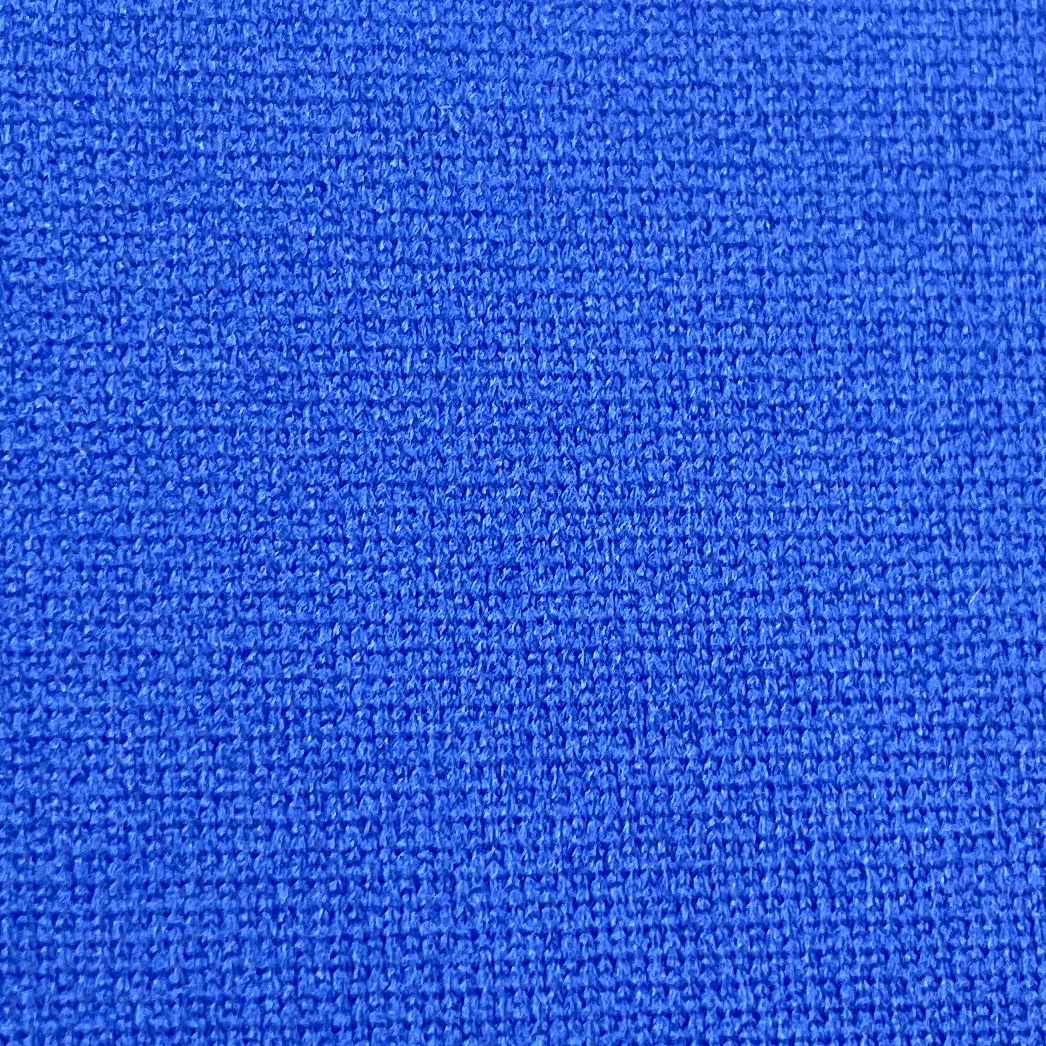 FOOTBALL JERSEYS FABRIC KF000411PERFORMANCE KNIT MATT & PLAIN HT045View Product →
Haining Yitai Knitting Co., Ltd, a performance knit supplier based in Haining, Zhejiang, publishes weight, structure and stretch data for its activewear fabric range, which lets a buyer compare bands before requesting a sample.
GSM alone never predicts fit. Two 220 gsm interlocks can differ by 30 percent in lengthwise stretch if one carries 12 percent elastane and the other 18 percent, and the higher-elastane version will recover faster after a squat, a sprint or a full day of wear.
Three specifications travel with the weight and should be written into the same document:
Hand feel, pilling and drape follow the same logic. A knit built from finer yarn at a higher stitch density reads smoother in the 210-230 gsm range than a coarser knit of the same weight, and it resists pilling to grade 4 on the ISO 12945-2 test more consistently. Buyers who specify weight alone end up approving a fabric that meets the number and misses the garment.
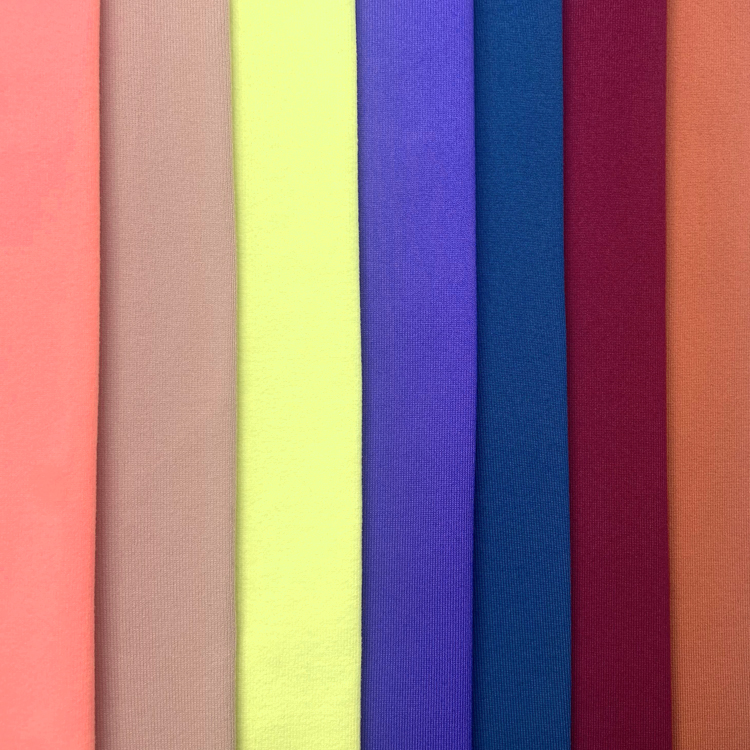 PERFORMANCE KNIT MATT & PLAIN HT045PERFORMANCE KNIT MATT & PLAIN HT045View Product →
Weight, yarn count and elastane percentage interact differently in each end use, and the breakdown of weight, elasticity and spandex selection shows how the same 240 gsm target resolves into three different constructions depending on the garment.
Raising GSM from 150 to 220 buys opacity, shape retention and abrasion life, and it costs drying speed: capillary channels per unit area fall as stitch density rises, so a 190-240 gsm interlock moves liquid moisture more slowly than a 140 gsm open single jersey when both are tested to AATCC 195.
Every GSM decision should be verified on the finished roll, not on the greige lot or the sample card: a cut test, a laundering test, a stretch test, a moisture test, a colourfastness test and a sealed reference roll together take about ten working days and prevent the errors that cost a full dye lot.
 BLACK QUICK DRY FABRIC HT1337PERFORMANCE KNIT MATT & PLAIN HT045View Product →
Quick-dry programmes in the 150-190 gsm band are the most sensitive to weight drift, because a 6 percent rise in GSM reduces the surface area available for evaporation and pushes drying time beyond the claims printed on the hangtag.
Convert GSM into running meters per kilogram before negotiating price: at 160 cm usable width, 180 gsm yields 3.47 meters per kilogram and 260 gsm yields 2.40 meters, so the same legging programme buys 31 percent fewer meters from the heavier cloth.
Two sourcing habits protect the margin. First, ask for GSM data on the finished roll from the same dye lot you will receive. Second, price by running meter and by kilogram at the same time, so a weight drift on one unit shows up immediately instead of at the cutting table.
No. A 260 gsm interlock with 10 percent elastane can fail a squat test that a well-built 220 gsm interlock passes, because opacity and recovery depend on stitch density, yarn count and elastane content as much as on mass. Judge weight inside its category band, not across bands.
Place team jerseys between 165 and 200 gsm in interlock or pique construction. That band provides enough density for sublimation print clarity on dark bases and enough body to reach 30,000 rubs on the ISO 12947-2 Martindale test at the shoulder and back panels.
Use 220-260 gsm for full-length leggings at 12-18 percent elastane, which is where squat-proof opacity holds up under studio lighting. A 180 gsm single jersey works for tops and lighter short tights but frequently shows through unless it is laminated or knitted at a higher stitch density.
At 160 cm width, moving from 180 gsm to 200 gsm drops yield from 3.47 to 3.13 meters per kilogram, about 10 percent fewer meters, so fabric consumption per garment rises about 11 percent at an unchanged kilogram price.

As Yitai, since 2004, we have manufactured sportswear knitted fabrics such as interlock fabric, nylon fabric, spandex fabric, polyester fabric etc. With excellent R&D group, marketing team, quality control system, experienced dyeing & finishing supporting facility and customer service system.
Haining Yitai Knitting Co., Ltd
No. 198 Canghai Road, Warp Knitting Zone, Haining City, Zhejiang, 314419, China Tel: +0086 135 6738 5757 Email: [email protected] [email protected] [email protected]FOLLOW US



 英语
 中文简体